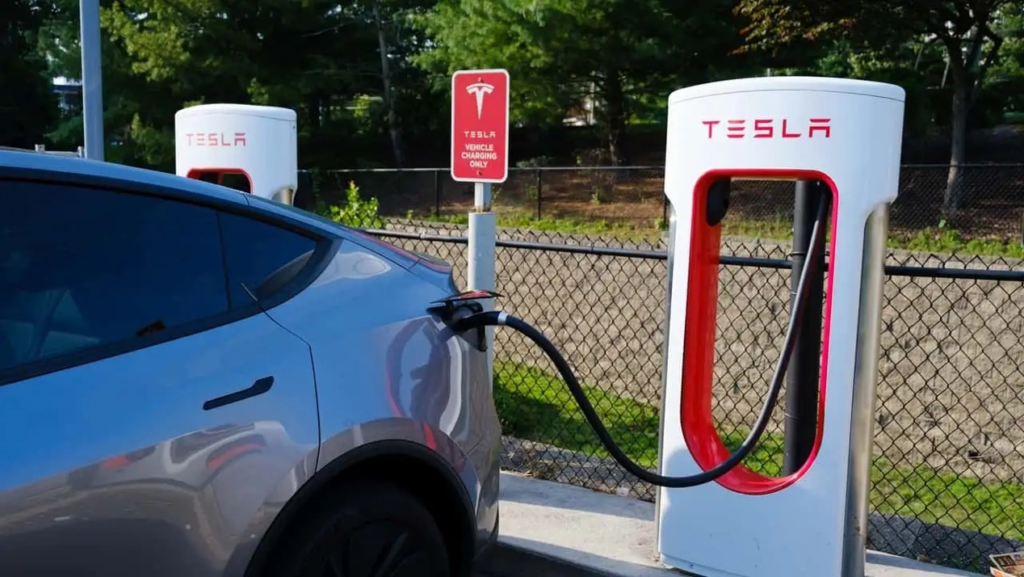
Studies on battery aging have also shown that EV batteries typically experience their fastest capacity loss during the earliest stages of their life cycle, with degradation slowing over time. But how much degradation should owners expect after six months of ownership and more than 16,000 miles (25,750 km) of driving, especially when fast charging is used more frequently than home charging?
A Canadian Tesla owner known online as “BCTESLAGUY” recently shared the battery health results of his Tesla Model Y after six months of use, and the findings were surprisingly impressive.
During this period, the vehicle received a total of 2,588 kWh through home AC charging and 2,888 kWh through DC fast charging, meaning fast charging accounted for the majority of the vehicle’s energy intake.
Initially skeptical of the “0% battery degradation” estimate reported by the Tesli monitoring app, the owner decided to perform a full battery health test using Tesla’s official calibration procedure.
The process involved discharging the battery to approximately 20%, connecting the vehicle to an AC charger capable of delivering at least 5 kW, allowing the battery to drain close to 0%, and then recharging it to 100%. The entire procedure took roughly 20 hours to complete.
The results exceeded expectations.
The owner had anticipated a battery health reading of around 96% to 97%, but the overnight test revealed that the battery retained 99% of its original capacity. Full-charge estimated range remained at 326 miles (525 km), essentially unchanged from when the vehicle was new.
The report also indicated that the battery pack has a nominal capacity of 82.8 kWh, confirming that the vehicle is equipped with Tesla’s Long Range nickel-based lithium-ion battery pack. This figure was unchanged from previous measurements.
One data point did show a slight change: cell voltage imbalance increased from 16 mV to 30 mV, although the owner did not consider this significant.
According to the owner, two charging habits may have contributed to the battery’s exceptional condition:
- Preconditioning the battery before every fast-charging session
• Limiting daily charging to 75% and rarely allowing the battery level to fall below 35%
He plans to continue using a combination of home charging and public fast charging and intends to repeat the battery health test in another six months to monitor long-term trends.
The test also suggests that owners of nickel-based lithium-ion batteries may not need to be overly concerned about frequent fast charging. While lithium iron phosphate (LFP) batteries are generally known to tolerate repeated full-charge cycles more effectively, maintaining a charging limit below 80% and avoiding very low battery levels appear to be effective strategies for preserving battery health regardless of chemistry.
Although a single six-month case study cannot settle the broader debate surrounding fast charging and battery longevity, it does challenge some of the more extreme concerns often expressed by EV owners.
The key takeaway is not that fast charging causes no degradation, but rather that charging habits matter far more than many people realize. Avoiding prolonged operation at very high or very low states of charge, preconditioning the battery before fast charging when possible, and reserving 100% charges primarily for long-distance trips may be among the most effective ways to maximize long-term battery health.