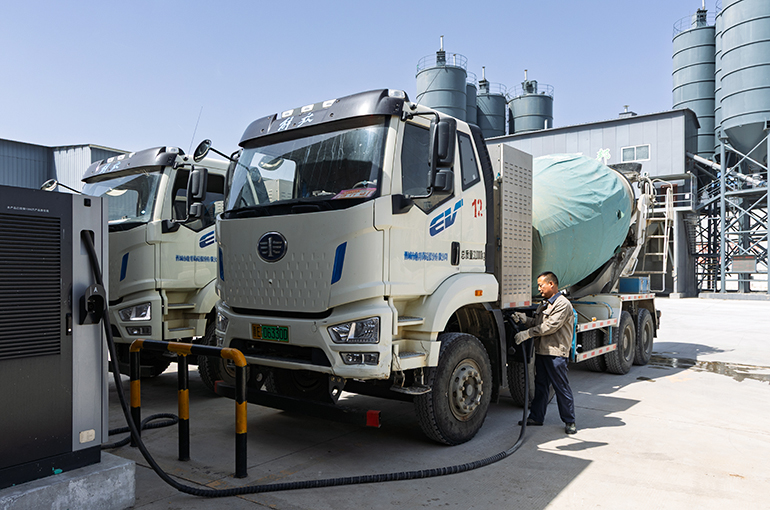
China has moved to ensure charging and battery-swapping facilities for new energy heavy-duty trucks are incorporated into future highway development, a step aimed at boosting the use of cleaner freight vehicles and supporting the country’s carbon-reduction objectives.
Under a blueprint jointly issued by the Ministry of Transport and 11 other government agencies, authorities plan to create a 30,000-kilometer zero-emission freight network by 2030. The initiative includes the construction of roughly 3,000 charging and battery-swapping stations for heavy trucks along major expressways, as well as hydrogen and other low-carbon fuel refueling facilities in strategic freight corridors.
The plan requires newly developed expressway service areas to either install such facilities or set aside land for future deployment. Projects involving highway expansion or upgrades must also take into account the development of clean-energy and energy-storage infrastructure.
Liu Xin, head of the Transport Planning and Research Institute under the Ministry of Transport, said the coordinated rollout of transport and energy infrastructure is expected to ease major constraints on the sector’s growth and support the wider adoption of new energy heavy-duty trucks.
While China has built a charging and battery-swapping network of more than 21 million facilities, publicly available high-power chargers suitable for heavy-duty trucks remain limited, according to Liang Linhe, chairman of Sany Heavy Truck. Dedicated charging spaces at highway service areas are still scarce, and replenishing a truck’s battery can take more than an hour, he added.
The shortage of charging and refueling infrastructure has largely restricted the operating radius of new energy heavy-duty trucks to between 300 kilometers and 500 kilometers, making long-distance operations difficult, Liang noted.
The blueprint also urges power grid companies to improve support for truck charging and swapping stations by factoring future electricity demand into grid planning and speeding up investment in regional distribution networks.
According to an industry source cited by Yicai, integrating charging infrastructure into highway construction projects effectively establishes energy-supply facilities for heavy trucks as a standard feature of China’s expressway system. The move is also expected to generate additional investment opportunities in grid expansion and modernization.
The government is targeting a 40 percent adoption rate for new energy heavy-duty trucks by 2030, with the fleet size expected to exceed 1.6 million vehicles nationwide.
Industry data from Cvworld.cn showed sales of new energy heavy-duty trucks reached 231,100 units last year, accounting for 29 percent of total heavy-truck sales. Huatai Securities estimated that the number of electric heavy trucks in operation nationwide had risen to about 384,000 by the end of the year.
The blueprint further states that new energy heavy-duty trucks should account for 18 percent of highway freight transport by 2030. In major air-pollution-control regions, such as the Beijing-Tianjin-Hebei area, electric vehicles will be required to represent at least 80 percent of heavy trucks operating on fixed short-distance routes.
Li Bin, a researcher at the China Electric Power Research Institute, said heavy-duty trucks play an outsized role in the transport sector’s decarbonization challenge. Although they make up only around 3 percent of China’s vehicle population, they are estimated to produce about half of all carbon emissions generated by road freight transport.